
Before the Halo
What Makes a Saint?

Dear UnMinders,
What makes a true saint?
Is it saffron robes and softened eyes?
A halo rented from the heavens?
A diet of silence and air?
Is it miracles, morals, or the ability to look permanently calm while chaos files past?
Or is a saint simply someone who forgot how to pretend?
Let us sit with this question like a child sits with a puddle. No hurry. No theology. Just curiosity with muddy feet.
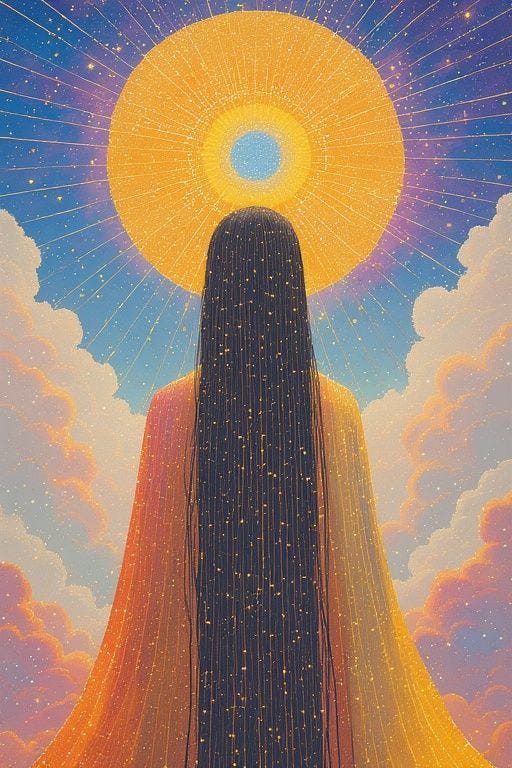
The world thinks saintliness is an achievement. A polished version of humanity. A spiritual upgrade with better ethics and fewer tantrums. The saint, we imagine, has conquered desire, disciplined the mind, and risen above the mess.
Zen smiles at this and spills the tea.
Saintliness is not a victory over life.
It is surrender to its original innocence.
The saint is not someone who learned something extraordinary.
The saint is someone who unlearned the unnecessary.
Watch a child before the world begins correcting them.
They laugh without strategy.
They cry without shame.
They trust without footnotes.
They ask inconvenient questions and accept impossible answers.
A child does not calculate love.
They are love, briefly distracted by toys.
Saintliness is this state, but without the toys.
The saint is not holy because they are pure.
They are pure because they stopped editing themselves.
We mistake saintliness for seriousness. But seriousness is always ego in a necktie. Saints are light because they are empty. Empty of self-importance. Empty of spiritual ambition. Empty of the exhausting project called “me.”
A saint can laugh at themselves because there is no one left to defend.
That is their miracle.
A monk asked, “Master, what is the mark of a saint?”
The master replied, “They are easily amused.”
Primal innocence is not ignorance. It is post-knowledge clarity. The saint has seen the games of power, identity, virtue, and transcendence and quietly opted out. Not in rebellion. In boredom.
The saint does not try to be good.
They are too busy being real.
Morality becomes natural when ego disappears. Compassion flows when there is no one calculating merit. Kindness becomes spontaneous when fear has packed its bags.
This is why saints can be dangerous. They cannot be manipulated by praise or threatened by blame. They are immune to prestige. Titles slide off them like rain off a leaf.
Why does a saint feel so ordinary when you meet one?
Because they are no longer performing.
The world rewards cleverness. Saints return to wonder.
The world worships complexity. Saints bow to simplicity.
The world polishes masks. Saints lose theirs and forget where they left it.
And here is the secret, revealed only at the end, because secrets like suspense:
A saint is not someone who rose above humanity.
A saint is someone who fell back into it.
Back into primal innocence.
Back into unguarded presence.
Back into life before the lie of separation.
Saintliness is not becoming special.
It is becoming original.
You were never meant to become a saint.
You were meant to stop becoming.
When innocence returns, holiness follows like a shadow.
No effort. No drama. No applause.
Just a human being, finally unafraid to be human.
Thank You for reading,
Manpreet Singh
Beautiful. Funny how so much progress later in life is actually going back to the truth.
Beautiful piece! The reframe of saintliness as unlearning rather than achieving something is really insightful. That line about being "easily amused" is perfect because it cuts through all the performative spirituality we see. I've noticed in my own life that the moments when I feel most centered are when I stop trying to optimize or become anything. Just curious, do you think primal innocence can coexist with intellectual rigor, or does knowlege inherently complicate that simplicty?